Dream meaning
Sensing a presence in the room
The short answer
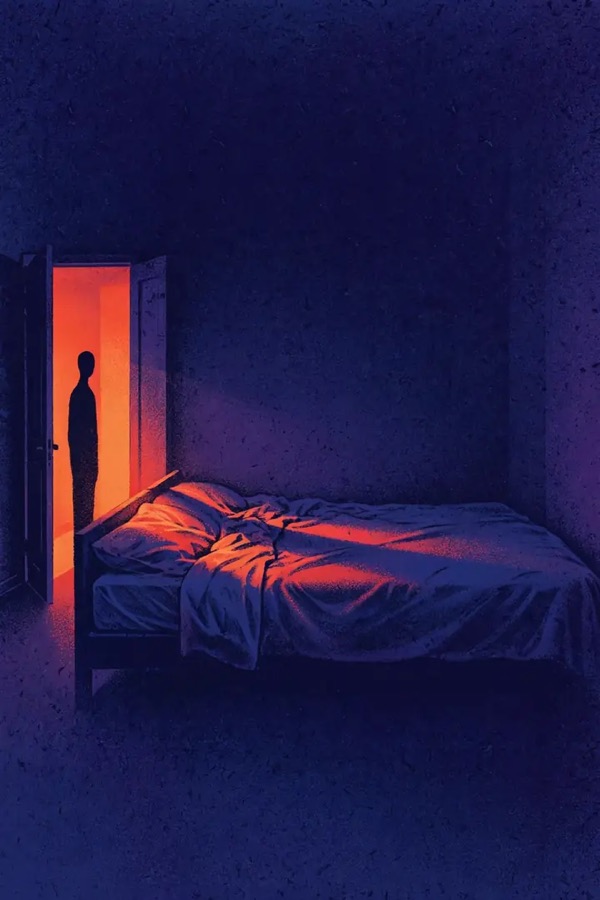
The vivid feeling that someone is in the room while you lie half awake is very common and has a known explanation: it often comes with sleep paralysis, when the body is still in REM sleep while the mind wakes. It feels intensely real and is usually frightening, but it is not dangerous.
48.3% of people in the study had had this dream. No. 10 of the 55 typical dreams · Nielsen et al., 2003
What does a dream about “Sensing a presence in the room” mean?
What psychologists say
Research on sleep paralysis finds that the sensed presence is one of its most frequent features, often with fear, pressure on the chest or shapes in the dark. It happens when REM sleep's muscle paralysis and dream imagery overlap with waking awareness. Stress, irregular sleep and sleeping on your back make episodes more likely.
Cheyne, 2003; Denis et al., 2018
The Jungian reading
A Jungian reading sees the presence as the unconscious made felt: something wants attention, and the threshold between sleep and waking gives it a body. The fear can say less about the presence than about how unfamiliar it is to let that part of you in.
Jung, 1964
In history and folklore
Almost every culture has a name for the night visitor: the Old Hag of Newfoundland, the incubus of medieval Europe, the pandafeche of Italian folklore. Folklore studies show these stories describe the same sleep paralysis experience across centuries.
Hufford, 1982
How common is this dream?
48.3% of people in the study had had this dream. From a survey of 1,181 first-year university students in three Canadian cities. No. 10 of the 55 typical dreams.
Common versions of this dream
Why can't I move when I feel the presence?
During REM sleep your muscles are switched off. In sleep paralysis you wake before that switch flips back, so you can't move for a few seconds or minutes.
Is the presence real?
It feels real because the brain's threat detection is active. Research describes it as a hallucination of the sleep-wake transition, not an external being.
How can I make it stop?
Regular sleep, less stress and avoiding sleeping on your back help. Focusing on moving a finger or slowing your breath can shorten an episode.
Dreams that often come with it
Had this dream? Tell it to Oneiros.
Oneiros reads your own dream, not a dictionary entry: what it was about, how it felt and what it may mean for you, and it notices when it comes back.
Oneiros offers reflective readings for self-discovery and entertainment. It is not a medical or psychological service.
Sources
- Nielsen, T. A., Zadra, A. L., Simard, V., Saucier, S., Stenstrom, P., Smith, C., & Kuiken, D. (2003). The typical dreams of Canadian university students. Dreaming, 13(4), 211–235. doi:10.1023/B:DREM.0000003144.40929.0b
- Cheyne, J. A. (2003). Sleep paralysis and the structure of waking-nightmare hallucinations. Dreaming, 13(3), 163–179. doi:10.1023/A:1025373412722
- Denis, D., French, C. C., & Gregory, A. M. (2018). A systematic review of variables associated with sleep paralysis. Sleep Medicine Reviews, 38, 141–157. doi:10.1016/j.smrv.2017.05.005
- Jung, C. G. (Ed.) (1964). Man and His Symbols. Aldus Books.
- Hufford, D. J. (1982). The Terror That Comes in the Night: An Experience-Centered Study of Supernatural Assault Traditions. University of Pennsylvania Press.