Dream meaning
Seeing a face very close to you
The short answer
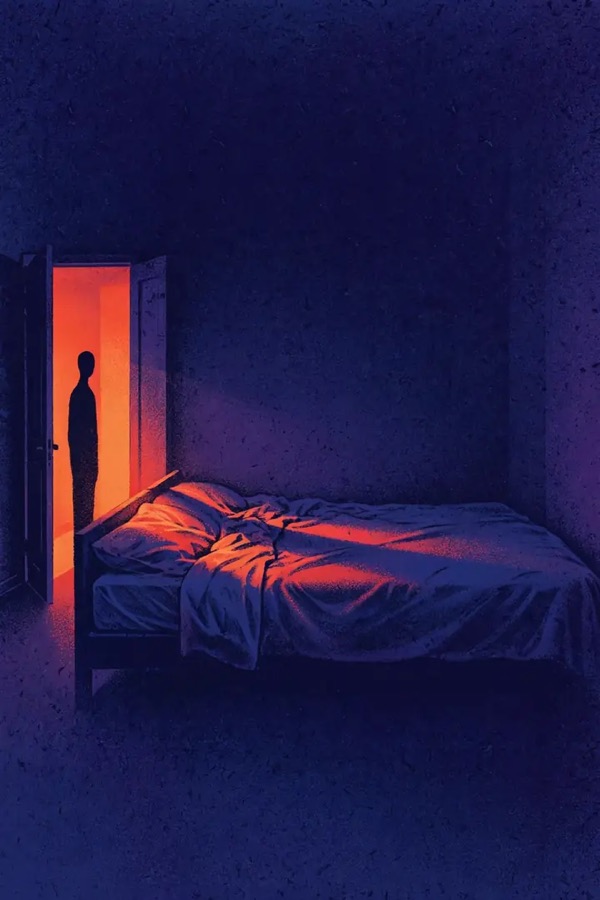
Seeing a face very close to yours, often on waking or falling asleep, is a striking experience. It is usually a hypnagogic or hypnopompic image, the brain's dream imagery overlapping with the edge of waking, and is closely linked to sleep paralysis.
23.5% of people in the study had had this dream. No. 33 of the 55 typical dreams · Nielsen et al., 2003
What does a dream about “Seeing a face very close to you” mean?
What psychologists say
Researchers added this theme to the Typical Dreams Questionnaire because people kept describing it. Faces are what the visual brain is most tuned to, so it readily produces them when the boundary between sleep and waking blurs. The experience is common and usually harmless, though it can be frightening.
Nielsen et al., 2003; Cheyne, 2003
The Jungian reading
A Jungian reading treats the face as an encounter with the other within: a figure from the unconscious looking directly at you. Whether it is kind, neutral or menacing reflects your relationship with that part of yourself.
Jung, 1964
In history and folklore
Faces looming at night appear in ghost stories and night-visitor folklore across cultures, often as a warning or a spirit seeking contact.
Hufford, 1982
How common is this dream?
23.5% of people in the study had had this dream. From a survey of 1,181 first-year university students in three Canadian cities. No. 33 of the 55 typical dreams.
Common versions of this dream
Is it a ghost?
Research explains it as imagery at the sleep-wake boundary. It feels real because perception and dreaming overlap.
What if I recognise the face?
A familiar face points to someone on your mind.
What if it happens often?
Frequent episodes are often linked with irregular sleep and stress; better sleep habits help.
Dreams that often come with it
Had this dream? Tell it to Oneiros.
Oneiros reads your own dream, not a dictionary entry: what it was about, how it felt and what it may mean for you, and it notices when it comes back.
Oneiros offers reflective readings for self-discovery and entertainment. It is not a medical or psychological service.
Sources
- Nielsen, T. A., Zadra, A. L., Simard, V., Saucier, S., Stenstrom, P., Smith, C., & Kuiken, D. (2003). The typical dreams of Canadian university students. Dreaming, 13(4), 211–235. doi:10.1023/B:DREM.0000003144.40929.0b
- Cheyne, J. A. (2003). Sleep paralysis and the structure of waking-nightmare hallucinations. Dreaming, 13(3), 163–179. doi:10.1023/A:1025373412722
- Jung, C. G. (Ed.) (1964). Man and His Symbols. Aldus Books.
- Hufford, D. J. (1982). The Terror That Comes in the Night: An Experience-Centered Study of Supernatural Assault Traditions. University of Pennsylvania Press.